
From Riyadh Food Courts to Dubai Malls: How Self-Ordering Kiosks Are Rewiring Gulf F&B
Walk into a mall food court in Riyadh on a Thursday evening, or a quick-service counter in Dubai at lunch, and the queue tells you the story. One cashier, a line of twelve, a menu board nobody has time to read. Across the Gulf, that picture is changing — self-service ordering and payment kiosks are moving from pilot projects into standard store layouts, pushed by a young, mobile-first customer base, rising operating costs, and national digitalization agendas that have made cashless payment a normal part of daily life.
A Region With Its Own Rhythm
The Gulf has its own rhythm, and the hardware has to match it. Lunch and evening peaks are sharp. Weekend traffic in malls can double within an hour. Ramadan shifts the entire day — a quiet afternoon followed by a rush that starts at sunset and does not slow down until well past midnight. A kiosk in this environment is not a showroom piece; it is a working terminal that has to take thousands of taps, survive a crowded corridor, and stay legible under bright mall lighting.
 Built Around the Screen
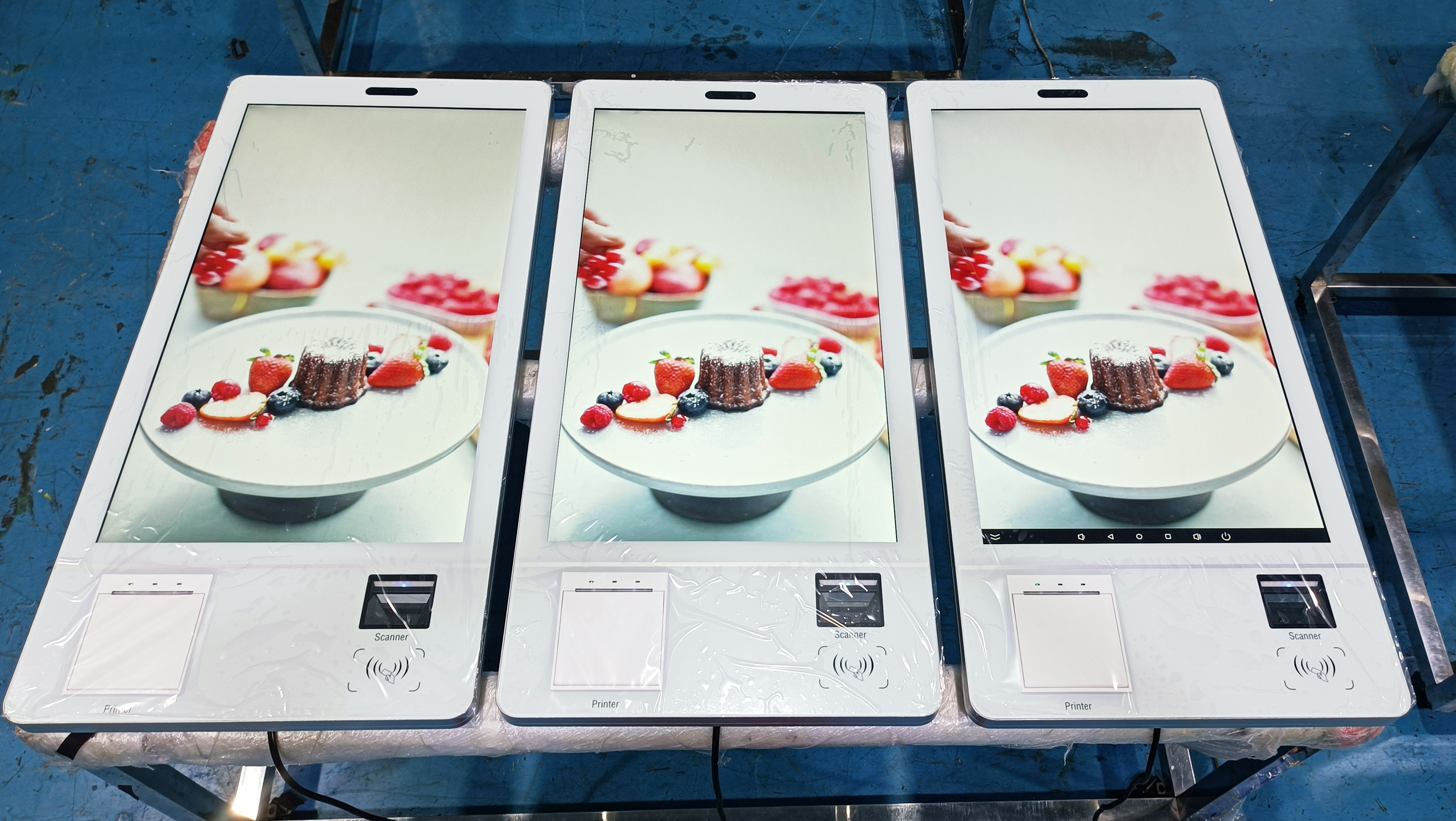
That starts with the display. A 10-point capacitive touch screen with tempered anti-fingerprint glass responds instantly, even when a customer is ordering in a hurry. Bilingual menus matter more here than in almost any other market — Arabic with right-to-left layout alongside English — and the interface has to switch cleanly without breaking the ordering flow. Under the screen sits a full-code QR scanner with fill light, ready for wallet payments, loyalty codes and promo barcodes, alongside card payment options that remain essential in the region. An 80mm thermal printer issues order slips and kitchen copies, with a side switch lock so staff can change paper in seconds during a rush.
The Body Has to Look the Part
SOSU’s self-service kiosks use a mild-steel enclosure with baking finish and an alloy frame — rigid enough for a busy food court, easy to wipe down, and clean enough to sit in a premium café or hotel lobby. The same platform supports multiple formats: a 15.6-inch countertop unit for tight service desks, a 21.5-inch floor-standing kiosk for entrances and lobby zones, or a wall-mounted terminal where floor space is scarce. Systems run on Android, Windows, Linux or Ubuntu, so the kiosk connects to existing POS software, kitchen display systems, and local payment gateways rather than forcing a rebuild.
What Operators Notice First
For operators, the value shows up fast. One terminal absorbs the ordering load of one or two counter staff during peak hours, and it never mishears a modifier or forgets an upsell. Customers who build their own order tend to add drinks and sides; menus can suggest combos at the exact moment of decision. Staff move from keying in orders to serving guests and handling exceptions. In a market where labour costs are rising and staffing a counter through a Ramadan rush is genuinely hard, that shift matters.
Making It Repeatable Is a Factory Problem
At SOSU’s Guangzhou base, established in 2009, self-service terminals are built through vertical production: sheet-metal fabrication, screen assembly, motherboard integration, peripheral fitting, software debugging and final testing all under one roof. The company holds ISO9001, ISO14001, CCC, CE, FCC and RoHS certifications, along with eight appearance-patent certifications. Because enclosure work stays in-house, a distributor can adjust size, colour, logo, mounting style, and peripheral set without handing the project to a third party—and prepare documentation support for SASO and SABER coordination alongside the shipment.
Quality Control Follows Real Store Conditions
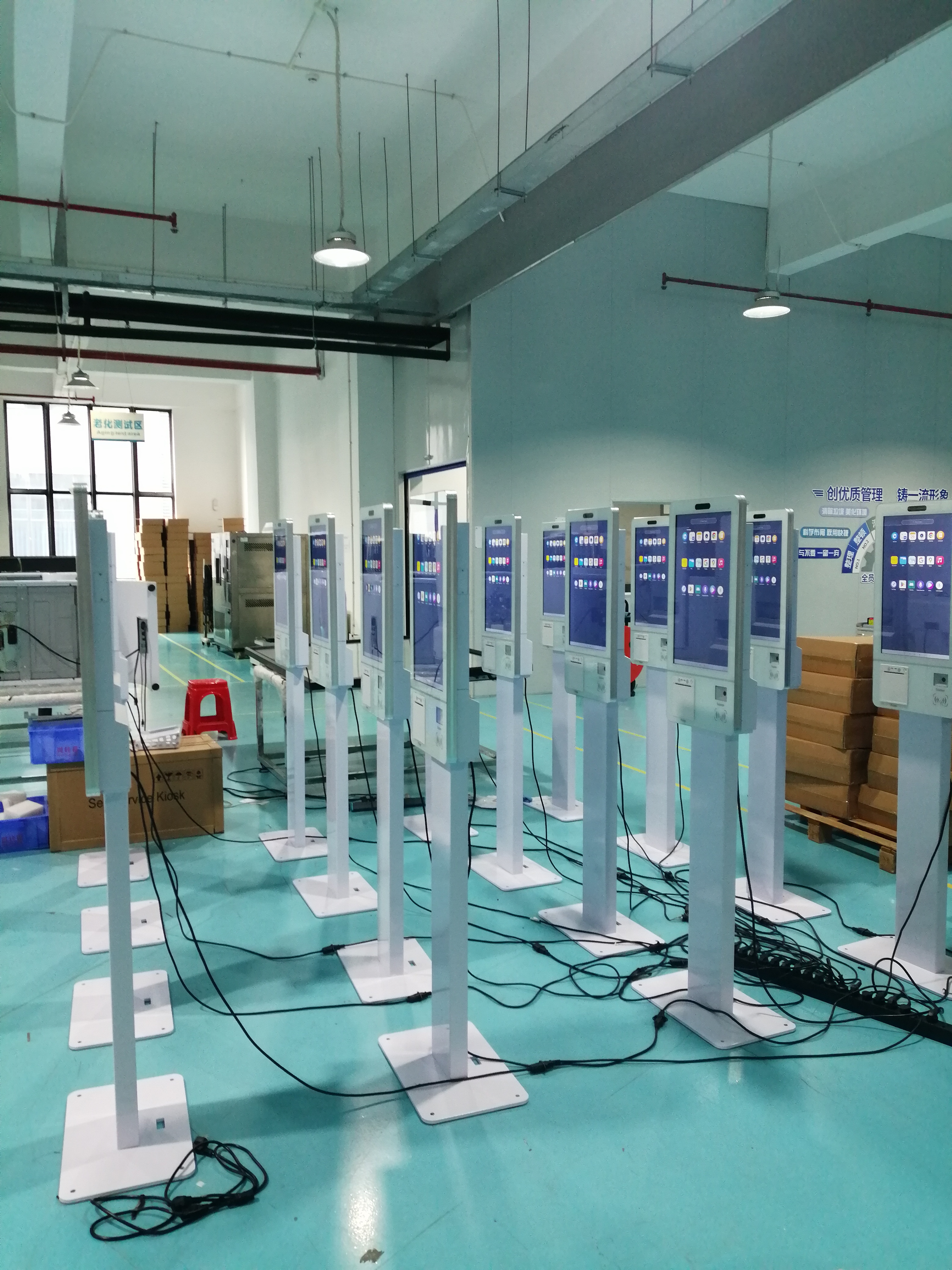
After assembly, every unit runs a full peripheral test: touch accuracy across the entire panel, QR scanning under bright and dim light, printer feed and cutter action, network and boot stability. Kiosks then enter an aging run, operating continuously to expose overheating, freezing, or peripheral faults before they ship — a check that matters in a region where ambient temperatures test every electronic component. Only terminals that clear every stage get packed.
Packing for Long Sea Freight
Foam inserts, reinforced cartons, and palletized loading protect the enclosure and screen in transit. Floor-standing units ship with protected stands; wall-mounted kits include anchors and hardware. Documentation and peripheral lists travel with the container, so distributors in Saudi Arabia, the UAE, Qatar, and Oman can deploy soon after arrival instead of chasing missing parts. With access to Nansha and Shekou ports, mixed-size containers load without stalling the schedule.
The Floor Tells the Story
Step onto the Guangzhou floor during a production week and the rhythm is visible. Sheet-metal shells move down the fabrication line. Technicians swipe test menus across rows of lit screens, switching between Arabic and English layouts. Scanners beep as code after code is read. In the aging area, kiosks run through a quiet overnight shift, status lights steady. At the loading dock, cartons stack into towers while a forklift threads between pallets and a truck backs in for the next Gulf-bound container.
The weekly board shows a steady mix: countertop units for cafés, floor-standing kiosks for QSR lobbies, wall-mounted terminals for compact retail counters. Distributors are reviewing samples; chain buyers are planning rollouts store by store.
 “The kiosk doesn’t make the store unmanned,” the production supervisor says, checking a batch sheet. “It makes the counter human again — the machine takes the transaction, the staff takes care of the guest.”
The Shift Underway
As more brands treat digital ordering as standard infrastructure, the terminals that win will not be the flashiest. They will be the ones that scan cleanly in bright light, print reliably at midnight, mount anywhere, and still look sharp after a year of mall traffic. In Guangzhou, the line keeps moving: steel formed, screens calibrated, scanners verified, terminals boxed and loaded — each one headed for a counter where the next order is already waiting to be tapped in.
SOSU Electronic Technology — self-service ordering kiosks built for the Gulf’s busiest hours.
Post time: Nov-19-2026